Out-of-home youth
A home that holds Jay's move from crisis to settled
At 16, Jay needed 24-hour support away from his family home. A 2:1 team, his clinicians and the right home helped him settle.
The situation before Myxa
Jay was 16 and living at home in Victoria with his parents and younger siblings. He is an affectionate young man who loves water play, music, and being out in the community. Jay has intellectual disability and complex support needs that affect how he understands risk, manages change, and regulates his emotions when things do not go the way he expects. Like many people with complex support needs, Jay communicates in ways that are not always verbal, and behaviour is often how he lets the people around him know how he is feeling.
Over time, those behaviours became harder for everyone to manage safely. Jay would drop to the ground, run towards roads, break windows, and sometimes hurt the people closest to him. His younger siblings loved him, but they did not always understand what his behaviour was trying to communicate, and it frightened them at times. His parents were exhausted, and respite providers had withdrawn because they could not meet his needs. It was a hard and emotional decision, but the family recognised Jay needed a different kind of support. Following assessment, it was determined that Jay required out-of-home accommodation with 24-hour support.
What the participant wanted to change
Jay does not set goals the way many of us do, so the people who know him best read them from what settles him, what he reaches for, and what helps him feel safe. The goals written on his behalf, in consultation with his family and clinical team, were simple but significant: a safe home with consistent support, a predictable daily routine, safe outings into the community, and ways for him to communicate and self-regulate that did not end in harm to himself or others.
For Jay's parents, the goal was just as important. They wanted a home where Jay would be safe, where familiar faces would show up for him each day, and where they could go back to simply being his family rather than his only source of support.
The support plan and transition
Before Jay moved in, Myxa gathered his functional behaviour assessment, Behaviour Support Plan, therapy reports and communication profile, and assessed the home itself. Every worker completed training in his plan and his medication protocol before their first shift.
His support was built around 2:1 at all waking hours, and two workers on a shift is not a roster decision. It is two defined roles. Support Worker 1 stays engaged with Jay the whole time, using his communication book, feeling cards and first-then visuals. Support Worker 2 prepares meals and medication, drives, and handles anything that would otherwise pull the first worker's attention away. The roles swap, but at any moment each worker knows which one they hold.
Underneath the structure, the goals were small and human. The first was Jay being able to show someone how he felt. Staff modelled the picture cards every day, in ordinary moments rather than only hard ones, until Jay could pick up a card and say he was happy or angry. Every time he did, someone responded, so the card was worth using. Then it went both ways: staff used the same cards, just as calmly, to tell Jay when a behaviour was not okay. It gave the workers a consistent way to be honest with him and gave Jay a way to understand what was being asked of him. What grew out of it was trust.
That trust was designed in rather than hoped for. A House Supervisor was appointed to Jay's home to run personalised inductions for every new worker and regular check-ins with the team, and recruitment and rostering worked to keep the same matched people on his shifts. Over time that became what Jay and his family noticed most: familiar faces, week after week.
What 2:1 support looks like across a day
Two workers on a shift is only justified where each has a defined role at each point of the day. This is a typical program day for Jay in his SDA home.
7:00am, waking and personal care
- Support Worker 1
- Stays with Jay, uses visuals to signal each step, supports showering and dressing at his pace
- Support Worker 2
- Prepares clothing, towels and the bathroom ahead of him, manages the rest of the home
- Why two workers
- Jay needs unbroken 1:1 engagement to stay regulated; a worker who breaks away to fetch items is a trigger
7:30am, medication
- Support Worker 1
- Keeps Jay engaged in a preferred activity away from the preparation area, then supports him to take his medication
- Support Worker 2
- Prepares and dispenses medication out of Jay's line of sight, then removes and stores it
- Why two workers
- Jay has grabbed and poured liquid medication when a single worker's attention moved to preparing it
8:00am, breakfast
- Support Worker 1
- Supports Jay to co-actively make his drink and breakfast, keeping him in the task
- Support Worker 2
- Manages the kitchen, food storage and anything left out on the bench
- Why two workers
- Food is a high-fixation area; items in view during preparation have led to escalation and property damage
9:30am, program session
- Support Worker 1
- Runs the session with Jay using his choice board and visuals, follows his lead between activities
- Support Worker 2
- Sets up and packs down each activity, keeps the sensory room and living areas ready for the next one
- Why two workers
- Lets the session flow without Jay being left unsupported between steps
12:00pm, lunch
- Support Worker 1
- Stays engaged with Jay at the table
- Support Worker 2
- Cooks, serves and clears
- Why two workers
- Same reasoning as breakfast
1:30pm, community outing or drive
- Support Worker 1
- Sits in the back with Jay, engages him in conversation and his car bag, watches for early warning signs, follows the car exit process on arrival
- Support Worker 2
- Drives, parks to plan, prepares the destination so there is no waiting
- Why two workers
- Jay has grabbed and pulled at the driver; the driver cannot engage and drive safely at the same time, and transfers near roads are his highest-risk moments
3:30pm, home and downtime
- Support Worker 1
- Engages Jay through the transition into the house, offers the sensory room or a preferred activity
- Support Worker 2
- Unlocks and prepares the home ahead of him so there is no waiting at the door
- Why two workers
- Waiting during a transition is a known trigger
6:00pm, dinner
- Support Worker 1
- Stays engaged with Jay at the table
- Support Worker 2
- Cooks, serves and clears
- Why two workers
- Same reasoning as breakfast
7:00pm, evening medication and wind-down
- Support Worker 1
- Engages Jay, then supports him to take his medication
- Support Worker 2
- Prepares and stores medication, prepares his room
- Why two workers
- Same reasoning as the morning
9:00pm to 7:00am, overnight
- Support Worker 1
- 1:1 active overnight support, awake and checking on Jay through the night
- Support Worker 2
- Not rostered overnight
- Why two workers
- Support steps down to 1:1 overnight in line with his assessed need
The roles swap through the day so no one worker carries the engagement load for a whole shift, but at any given moment both workers know which role they hold.
How the Myxa team worked together
Car travel became the test of the whole arrangement. Jay loves a drive, but in the car he would grab the driver's hair, bite and kick at the seats. About a year in, the team had to stop non-essential drives. Rather than leave it there, Myxa raised it with the behaviour support practitioner and the care team as a restriction that needed a plan to come off.
What followed was joint work between the House Supervisor, support workers, the behaviour support practitioner and the occupational therapist: reflective practice sessions where real drives were talked through, filmed modelling sessions, with the family's consent, so new workers could see the strategies in use, and a staged return to driving. Short local trips first, then visits to the family home, then a set Saturday drive, with each stage reviewed before the next.
None of that works if only one part of the organisation is doing its job. Recruitment matched workers on experience and temperament. Rostering gave the House Supervisor notice of new staff so induction came first. The training team ran the plan and medication sessions. Admin kept incident reports, data and NDIA paperwork moving so decisions were made on evidence. The Authorised Program Officer reviewed every restrictive practice, including the driving restriction, with a plan to reduce it. Management kept the family informed and made sure what the support team was seeing reached the people who could act on it.
The relationships outside Myxa mattered just as much. Jay's care team met monthly, with major incidents shared within 24 hours, and decisions were made in that room rather than by one service alone:
- Jay's father and family, his decision-makers and the people who know him best
- The behaviour support practitioner, who held the plan, ran reflective practice and led the reduction of restrictive practices
- The occupational therapist, on functional capacity, the home environment and sensory supports
- The physiotherapist, on mobility and safe physical support
- The speech pathologist, on his communication system and making sure every worker could use it
- The support coordinator, holding the plan together across services
- DFFH and the NDIA, on funding and the living arrangement
- Myxa's House Supervisor, SIL Manager and Authorised Program Officer, bringing what the team was seeing day to day
His Tuesday and Thursday program came out of that room. The occupational therapist, physiotherapist and speech pathologist each shaped it, the support team tested it on real days, and the visuals and choice boards came from that loop. When everyone can see the same picture, the plan reflects the young person rather than any one service's view of him.
The move to his own home
The harder stretch came in the interim property, where Jay lived while waiting for SDA funding to become available at 18, in a home never built for his support needs. Property damage was significant and his behaviours escalated. Myxa worked with the landlord on more robust fittings and with the family and DFFH on the NDIA claim, so the cost did not land on the household.
The way out was planned, not waited for. Myxa worked with the SDA provider to find a property that actually suited Jay, looking at layout, robustness and whether the home could hold his support model, and with the support coordinator and care team on the transition itself: the funding pathway, the timing around his eighteenth birthday, the environmental assessments, and how to move him without losing the team and routines he relied on.
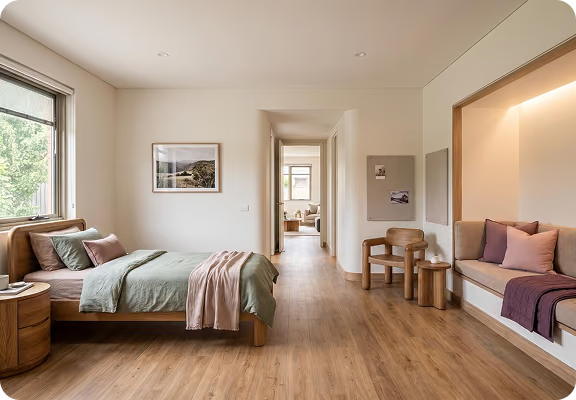
Myxa's property team then fitted the home out around Jay, working from the occupational therapist's recommendations and what the team had learned in the interim property: a sensory room with a chalkboard wall he can use whenever he likes, reinforced walls and robust fittings where damage had happened before, open space between the kitchen and living areas, and a clear path to the car. The aim was not an indestructible house. It was a home with room to move and settle, so there is less to push against.
The outcome
Jay moved into his SDA home in April this year. He is settled, and property damage is minimal. His family visit regularly, often over a fish and chips dinner, and he goes back to the family home to spend time with them. The bond between Jay and his family is a special thing to see, and it is there because he is somewhere safe enough for them to simply be his family again.
He is out in the community, and his favourite outing is the local airport, watching planes take off and land. His Tuesday and Thursday program, built with his therapists around his sensory needs, anchors his week, and the same visuals and choice boards run through the rest of it. Car travel is back too. The staged return held, and a drive is now part of an ordinary week rather than a risk the team manages around.
What changed was not one thing working. It was the home being right for him, the clinicians and the support team designing his days together, and a staff team that stayed with him through the worst of it.